-
Harnad and HAL
I would be surprised if Stevan Harnad, well-known Canadian cognitive scientist, has never watched Stanley Kubrick’s iconic 2001: A Space Odyssey, not least because the voice of HAL 9000, the rogue computer aboard the fictional spaceship Discovery One, was done by celebrated Canadian actor Douglas Rain. The final exchange between HAL and sole surviving astronaut… Continue reading
-
Tefko Saracevic
I am saddened to hear of the recent death of Tefko Saracevic, one of the giants in information retrieval and relevance. A distinguished professor emeritus at Rutgers, his was a name known throughout the international LIS community. Although I frequently cited his work on relevance (as did almost all researchers in the area), I only… Continue reading
-
“Discourse Synthesis” and the Crater of Doom
In an earlier post, I mentioned that I have a “mind of paper” in that much of what I believe I know is actually based on works I’ve read over the decades. One important influence was the late Raymond McInnis, an academic librarian at Western Washington University, who probably should have been cited as a… Continue reading
-
The Dog Whistle Dataset
The topic of “coded rhetoric” (often known as “dog whistles“) particularly in research on political discourse has become even more popular, probably due to the apparent increase in instances as well as in the easier access to computational tools for analysis. This is a fascinating use of keywords in its utilization of “hidden meanings” that… Continue reading
-
The Mind of Paper
Okay, I’m taking advantage of an obvious typo (page 51) in an interesting article by Manuela L. Ungureanu (“Olson’s Domestication of Goody’s Literacy Hypothesis: (How) Can Philosophers of Language Help?”) on David Olson’s The Mind on Paper, just because I like the way changing a single consonant in a single preposition can make such a… Continue reading
-
The Relevance of Symbolic Belief
I cited both of Dan Sperber and Deirdre Wilson‘s books on relevance (their 1986 Relevance: Communication and Cognition and their 2012 Meaning and Relevance in Chapter 4, so I was quite interested to see Sperber briefly mentioned in the New Yorker’s story on the phenomenology of misinformation, in connection with his distinction between “factual” and… Continue reading
-
The Listness of Lists
I cited Ben Highmore’s excellent “Keywords and Keywording” in chapter 4 as a contemporary introduction to Raymond Williams’ classic book Keywords (and I’ve also linked here to the book’s Wikipedia entry in hopes that someone will edit that in accordance with its importance.) In any case, Highmore is what he calls a cultural theorist “of… Continue reading
-
Political Keywords: Using Language That Uses Us
I cited this 20 year-old book by Roderick Hart and his coauthors in my Chapter 4 as an example of how the keyword analytic approach made famous by cultural theorist Raymond Williams is being used in various fields, but I didn’t go into detail about the book itself or the political keywords analyzed there. I… Continue reading
-
Bureaucracy Now!
In chapter 6, I highlighted the gradual transition to “modernity” by noting that: “The diffusion of modern technologies can be tracked by the initial dates in the dictionary for the published use of such neologisms as newspaper (1667), bureaucracy (1759), telegraph (1793), steamship (1819), railroad (1822), analytical engine (1843), telephone (1864), and typewriter (1868), all… Continue reading
-
Dominant Terminologies
Still on the topic of relevant research published right around the time my own book was in press, so here’s another item of interest from the September 2023 issue of Journal of Data and Information Science. Yves Fassin and Ronald Rousseau suggest in their “The Notion of Dominant Terminology in Bibliometric Research” that, like the… Continue reading
About THIS SITE
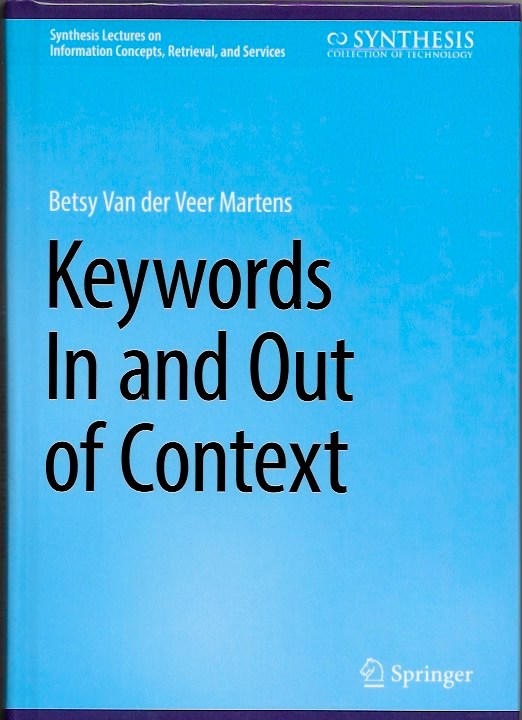
This site is intended to provide additional information related to my book Keywords In and Out of Context, published in Springer’s Synthesis Lectures on Information Concepts, Retrieval, and Services series.
I am Betsy Van der Veer Martens, professor emerita at the University of Oklahoma’s School of Library & Information Studies, and my most recent article is “On Thresholds: Signs, Symbols, and Significance” in the Journal of Documentation.
 Keywords In and Out of Context