-
Library & Information Science Research: Present, Past, Future
I have neglected this blog for the past few months as I’ve been immersed in writing a guest editorial at the invitation of my friend Dr. June Abbas, editor of the journal Library & Information Science Research. The piece celebrates the journal’s 45 years of publication and reviews some of their most significant papers over Continue reading
-
April 17 Webinar on Library Trends’ Special Issue on Design and the Philosophy of Information!
On April 17, 2025, Library Trends will host a webinar featuring the latest issue, Library Trends 73 (1–2). Inspired by the contributions of Marcia Bates, this issue, “Design and the Philosophy of Information,” highlights the cultural, social, and philosophical dimensions of information design. Ken Herold served as guest editor of this issue, which is freely Continue reading
-
Bezos and Bierce
3/12/25: Ruth Marcus, celebrated columnist at the Washington Post for over 40 years, has now resigned due to Bezos’s mandate that the Opinions column at the Post will now be limited only to those opinions supportive of “personal liberty” and the “free market.” Her opinion, printed here in the New Yorker, makes for painful reading Continue reading
-
Design and the Philosophy of Information
I’m delighted to announce some good news in this post (after the recent spate of disheartening ones about recent events that I’ve felt compelled to write): the special issue on “Design and the Philosophy of Information” has just been published in Library Trends. This is the third special issue in Library Trends on the topic Continue reading
-
Vonnegutted
is a word I’ve just invented to describe the devastation one can feel upon discovering that one’s view of reality is also largely shaped by one’s own lack of experience. For instance, although I was aware that American author Kurt Vonnegut died in 2007 (coincidentally, the year in which my own father, also a World Continue reading
-
Counting Coups
The phrase “counting coup” is obviously not of Native American origin, but rather one first applied by French-speaking traders (“compte de coup“) to describe the Plains Indian tradition of a warrior coming close enough to an enemy to strike him with a stick rather than simply killing him, which was considered a display of courage Continue reading
-
Forbidden Words
As linked from the Archivists’ Think Tank: 404Media offers a behind-the-scenes look on what’s going on right now in initial attempts to purge all mentions of “forbidden words” (those relevant to “diversity, equity, and inclusion” ) in U.S. government databases. Here’s an updated list of “forbidden words” at the National Security Agency from Popular Information, Continue reading
-
So Much for Search
Here’s a well-written and well-informed article from the current MIT Technology Review on the demise of search engines as we know them: https://www.technologyreview.com/2025/01/06/1108679/ai-generative-search-internet-breakthroughs/ (albeit with a positive PR spin, since the main interviewee is Google CEO Sundar Pichai, who describes AI Overviews as “one of the most positive changes we’ve done to search in a Continue reading
-
The Lure of Associates
While considerable research attention is being devoted to how large language models are pretrained through exposure to vast textual networks to analyze patterns in order to predict word sequence (see this bibliometric overview in the current issue of Information), today there is comparatively little attention being paid to how children learn language (which is, of Continue reading
-
Flattening the Memex
Inspired by Stevan Harnad’s example (though without his genius, alas), I input the final few pages of Vannevar Bush’s famous 1945 article in The Atlantic (“As We May Think”) into ChatGPT just now. Bush’s piece is a seminal text in LIS, as his description of the Memex is often (though not always) considered to prefigure Continue reading
-
Harnad and HAL
I would be surprised if Stevan Harnad, well-known Canadian cognitive scientist, has never watched Stanley Kubrick’s iconic 2001: A Space Odyssey, not least because the voice of HAL 9000, the rogue computer aboard the fictional spaceship Discovery One, was done by celebrated Canadian actor Douglas Rain. The final exchange between HAL and sole surviving astronaut Continue reading
-
Tefko Saracevic
I am saddened to hear of the recent death of Tefko Saracevic, one of the giants in information retrieval and relevance. A distinguished professor emeritus at Rutgers, his was a name known throughout the international LIS community. Although I frequently cited his work on relevance (as did almost all researchers in the area), I only Continue reading
-
“Discourse Synthesis” and the Crater of Doom
In an earlier post, I mentioned that I have a “mind of paper” in that much of what I believe I know is actually based on works I’ve read over the decades. One important influence was the late Raymond McInnis, an academic librarian at Western Washington University, who probably should have been cited as a Continue reading
-
The Dog Whistle Dataset
The topic of “coded rhetoric” (often known as “dog whistles“) particularly in research on political discourse has become even more popular, probably due to the apparent increase in instances as well as in the easier access to computational tools for analysis. This is a fascinating use of keywords in its utilization of “hidden meanings” that Continue reading
-
The Mind of Paper
Okay, I’m taking advantage of an obvious typo (page 51) in an interesting article by Manuela L. Ungureanu (“Olson’s Domestication of Goody’s Literacy Hypothesis: (How) Can Philosophers of Language Help?”) on David Olson’s The Mind on Paper, just because I like the way changing a single consonant in a single preposition can make such a Continue reading
-
The Relevance of Symbolic Belief
I cited both of Dan Sperber and Deirdre Wilson‘s books on relevance (their 1986 Relevance: Communication and Cognition and their 2012 Meaning and Relevance in Chapter 4, so I was quite interested to see Sperber briefly mentioned in the New Yorker’s story on the phenomenology of misinformation, in connection with his distinction between “factual” and Continue reading
-
The Listness of Lists
I cited Ben Highmore’s excellent “Keywords and Keywording” in chapter 4 as a contemporary introduction to Raymond Williams’ classic book Keywords (and I’ve also linked here to the book’s Wikipedia entry in hopes that someone will edit that in accordance with its importance.) In any case, Highmore is what he calls a cultural theorist “of Continue reading
-
Political Keywords: Using Language That Uses Us
I cited this 20 year-old book by Roderick Hart and his coauthors in my Chapter 4 as an example of how the keyword analytic approach made famous by cultural theorist Raymond Williams is being used in various fields, but I didn’t go into detail about the book itself or the political keywords analyzed there. I Continue reading
-
Bureaucracy Now!
In chapter 6, I highlighted the gradual transition to “modernity” by noting that: “The diffusion of modern technologies can be tracked by the initial dates in the dictionary for the published use of such neologisms as newspaper (1667), bureaucracy (1759), telegraph (1793), steamship (1819), railroad (1822), analytical engine (1843), telephone (1864), and typewriter (1868), all Continue reading
-
Dominant Terminologies
Still on the topic of relevant research published right around the time my own book was in press, so here’s another item of interest from the September 2023 issue of Journal of Data and Information Science. Yves Fassin and Ronald Rousseau suggest in their “The Notion of Dominant Terminology in Bibliometric Research” that, like the Continue reading
-
Catachresis If You Can
I didn’t have a chance to read Ted Striphas’s latest book, Algorithmic Culture Before the Internet, before mine came out, because it was published at roughly the same time last summer. I had previously read and enjoyed his 2011 The Late Age of Print, about the history of the American book industry, though I should Continue reading
-
Telltale Terminology
According to Ars Technica, some researchers in Germany have been investigating ways in which to determine whether papers have been AI-edited, and, of course, words are key to all these processes. Using a corpus of 14 million PubMed abstracts from 2010-2024, the researchers identified word frequency changes, finding for instance that the use of “Ebola” Continue reading
-
When Words Are Key
Well, here’s an empirical endeavor (studying the keyword choices of participants in a workshop at the 2018 iSchool conference and of iSchool directors) that I wouldn’t have thought of, using Raymond Williams’ cultural keyword analytics and applying Arthur Frank’s notion of “socio-narratology” to keywords as “stories.” Unsurprisingly, there was no consensus in the various participants’ Continue reading
-
On Indexing as an Idea
“On Indexing: The Birth and Early Development of an Idea” by Giancarlo Abbamonte and the late Craig Kallendorf wasn’t published until after my book went to press, so I was unaware of this excellent article on the intellectual history of indexing until recently, when I was casually looking for new citations to the work of Continue reading
-
Donna West and the Dawn of the Deictic
I happen to be visiting in Ithaca this month, and I’m reminded that Donna West of nearby SUNY Cortland is one of the leading scholars in deictic theory, which in her hands has become a fascinating mix of Peirce, Piaget, and empirical research on preschoolers’ development of semiotic capabilities. Although I didn’t cite her work Continue reading
-
The dark supply-side of keyword monetization
Ahmad, Sens, Eesley & Brynjolfsson have just published a study in Nature that shows how ill-informed most corporate advertising execs still seem to be about where their online ads are appearing, an ignorance which also appears to be funding a variety of misinformation-oriented websites. I noted in Chapter 10 that Google has made it increasingly Continue reading
-
Cevolini: Socio-Evolutionary Aspects of Relevance
Thinking a little further about Niklas Luhmann and his card index file (which is available online here, though mostly in German, and here is an excellent article about it by project director Johannes F.K. Schmidt), I am reminded of Alberto Cevolini’s work on indexing, which continues to intrigue me. I briefly cited his 2014 “Indexing Continue reading
-
Complete, Accessible, Now (and Then)
I just saw the special issue on “Entangled Temporalities” from the Journal of the History of Knowledge (open access: check it out here!) and was particularly taken by Hansun Hsiung’s “Complete, Accessible, Now: What is Living and What is Dead in the Research Library” which deals with the history of academic library collections in the Continue reading
-
Keywords in the Emergency Room
I didn’t give many examples of keywords actually at work in the book, so I’m taking this opportunity to point to some recent examples of interest. The first is from the AEM Education and Training journal, which deals with emergency medicine, and is titled, “The Keyword Effect: A Grounded Theory Study Exploring the Role of Continue reading
-
Oh, Krapp!
I’m in love with Peter Krapp, professor of media at UC-Irvine, thanks to his woefully undercited “Paper Slips.” Krapp translated Markus Krajewski’s 2011 Paper Machines: About Cards & Catalogues, 1548-1929 from the German, which was one of the sources for my own Chapter 7, and went on to write “Paper Slips,” the first chapter in Continue reading
-
Mithen and Metaphor
Neanderthal language capabilities are back in the news. According to well-known prehistorian Steven Mithen (whose “Hmmmmm” theory of language evolution I cited in Chapter 3), “the evidence points to key differences in the brains of our species and those of Neanderthals that allowed modern humans (H. sapiens) to come up with abstract and complex ideas Continue reading
-
My Missing Foreword
I have been contemplating the fact that I only cited Ronald Day once (his analysis of the “conduit metaphor” in Chapter 4) in my book, even though I have always admired his thinking, especially his continued work in critical theory. Anyway, I realized today, rereading his The Modern Invention of Information (one of the suggested Continue reading
-
Walter Ong: The Word Ongoing
I worked in marketing at Cornell University Press in Ithaca while completing my dissertation years ago, and one book on our backlist there happened to be Walter Ong’s 1977 Interfaces of the Word: Studies in the Evolution of Consciousness and Culture, which is one of the lesser-known of his several works on “the word” (his Continue reading
-
La Bella Vita (Homage to Bella Hass Weinberg!)
One of the reasons that I chose to create this “post-book” blog is to have a place in which I can add important findings of which I was not aware while I was writing Keywords In and Out of Context. This allows me to live la bella vita as a professor emerita, by which I Continue reading
-
Arguing the Anthropocene
Today is Earth Day, which I remember celebrating in my high school science class way back in 1970, though, as I recall, it mostly involved picking up trash around our school grounds (including cigarette butts from the “student smoking” area, which back then was an officially sanctioned part of school life.) In any event, I’m Continue reading
-
Wittgenstein and the Tip of the Tongue Phenomenon
The “tip of the tongue” phenomenon is a fairly common situation in which someone is unable to retrieve a known word (usually a noun or proper name) without a protracted series of attempts at associated words or ideas to prompt one’s memory. This has been the subject of substantial research, since the causes remain unknown. Continue reading
-
Evolving Words
I mentioned Chomsky’s “Merge” hypothesis briefly in Chapter 2, but this is another topic that merits (and has certainly received) many chapters (and books) of its own. Some of the more interesting recent articles that have dealt with aspects of “Merge” in reference to the evolution of language include: Hartmann’s 2020 “Language Change and Language Continue reading
-
The Symbol Ungrounding Problem
Terrence Deacon‘s 1997 The Symbolic Species is briefly mentioned in Chapter 3, but his body of work could undoubtedly have occupied multiple chapters (even if we didn’t mention his brilliant discussion of the limitations of Shannon’s information theory in “Information and Reference”) as he is a leader in the emergence of semiotic cognitive neuroscience, which Continue reading
-
How to Do Things With Non-Words
There is so much going on with animal communication research, particularly in relation to the evolution of human language (far more than the brief account that I provided in Chapter 2), that I thought I’d start this post with a link to Berthet and colleagues’ 2023 primer on “Animal Linguistics” in Biological Reviews, which provides Continue reading
-
100 Years of “The Meaning of Meaning”
2023 marks the 100th anniversary of the publication of C. K. (Charles Kay) Ogden and I. A. (Ivor Armstrong) Richards’ 1923 book, The Meaning of Meaning: A Study of the Influence of Language on Thought and of the Science of Symbolism, which the late Umberto Eco termed “A seminal book, whose merit was to say Continue reading
-
Hockett and How to Learn Martian
Charles (“Chas”) Hockett of Cornell University was a towering figure in linguistics during the 1950s and 1960s, primarily as a leading proponent of Leonard Bloomfield’s approach to structural linguistics, which purported to offer a systematic, scientific approach to the study of languages, but which has suffered a dramatic decline in popularity in America during the Continue reading
-
Call for Papers: Design in the Philosophy of Information
One of my interests has always been in the philosophy of information as embodied in Luciano Floridi’s ongoing PI project, especially his Principia Philosophiae Informationis. So I am particularly happy to share this new call for papers from guest editor Ken Herold on the philosophy of information and design to be published as a forthcoming Continue reading
-
Crossing the Symbolic Threshold
Further related to my “semiotic thresholds” paper in the Journal of Documentation, I noted on page 1016 that “Eco’s upper boundaries (1976, pp. 21–28) are delineated by a presumed threshold between semiosis and symbolism, a milestone in hominin history, as symbolic cognition must have been present prior to the development of language capabilities and has Continue reading
-
On Thresholds
I am happy to say that my most recent article (“On Thresholds: Signs, Symbols, and Significance“) has now been published in Volume 79 issue 4 of the Journal of Documentation. This was material originally intended for my book but which ended up not being as directly relevant to “keywords” as the other chapters so I Continue reading
-
Sebeok and “Speculative Semiotics”
In Chapter Two of my book, I very briefly mention one of the key figures in the study of cross-species communication: the late Thomas Sebeok. Born in Hungary, he came to the United States in 1937, graduated from the University of Chicago with a bachelor’s degree and from Princeton University with master’s and doctoral degrees. Continue reading
-
Arbib on “Aboutness”
One of the great pleasures of writing a book is having the opportunity to become more familiar with the work of those perhaps not directly in one’s own discipline (whatever that may be) but a knowledge of whose work may immeasurably enrich one’s own. Even though I had come across The Study of Information: Interdisciplinary Continue reading
-
Representation, Reference, Relevance, Retention
are the four fundamentals on which LIS is built, as I argue in Chapter 1, and yet the very complex physical components that underlie all of these abilities (sight, voice, hearing, memory) come in for almost no discussion within the field, though they obviously affect whether and how we can make use of information resources. Continue reading
-
Thoughts on the Languages of Thought
The “language of thought hypothesis” (LoTH), famously associated with the late Jerry Fodor and not particularly popular in recent years, appears to be recovering some ground, according to Mandelbaum and colleagues, whose “Problems and Mysteries of the Many Languages of Thought” I cited in Chapter 1. Mandelbaum develops this further with colleagues Quilty-Dunn and Porot Continue reading
-
The Evolution of Language by Sexual Selection?
I mentioned Robert Worden’s “The Evolution of Language by Sexual Selection” in Chapter 1, as he offers an appealing hypothesis as to the role that language played in human evolution: that what may have begun as a very task-oriented method of communication for group activities only slightly advanced from that of other primates eventually became Continue reading
-
Closing the Book
One of the problems with having finished a book is that it’s only then that you realize how much more you could have done with it. But my publisher has been enormously patient with me as I worked on this project, so it is clearly time for my final draft to be final: no more Continue reading
About THIS SITE
This site is intended to provide additional information related to my book Keywords In and Out of Context, published in Springer’s Synthesis Lectures on Information Concepts, Retrieval, and Services series.
I am Betsy Van der Veer Martens, professor emerita at the University of Oklahoma’s School of Library & Information Studies, and my most recent article is “On Thresholds: Signs, Symbols, and Significance” in the Journal of Documentation.
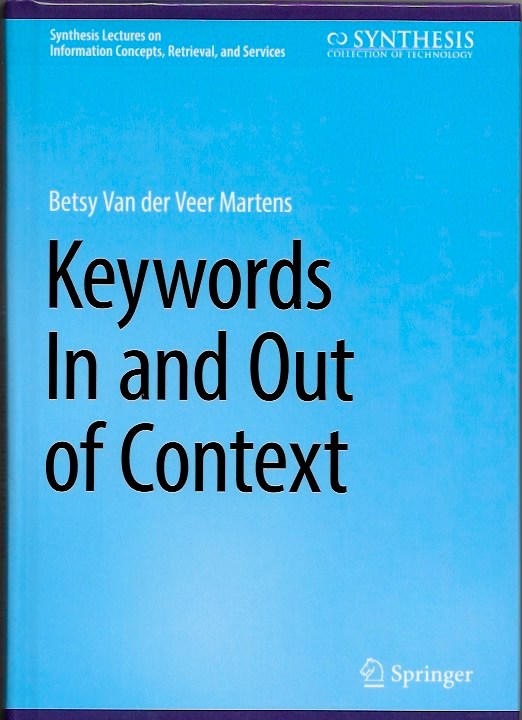
 Keywords In and Out of Context