-
Hockett and How to Learn Martian
Charles (“Chas”) Hockett of Cornell University was a towering figure in linguistics during the 1950s and 1960s, primarily as a leading proponent of Leonard Bloomfield’s approach to structural linguistics, which purported to offer a systematic, scientific approach to the study of languages, but which has suffered a dramatic decline in popularity in America during the… Continue reading
-
Call for Papers: Design in the Philosophy of Information
One of my interests has always been in the philosophy of information as embodied in Luciano Floridi’s ongoing PI project, especially his Principia Philosophiae Informationis. So I am particularly happy to share this new call for papers from guest editor Ken Herold on the philosophy of information and design to be published as a forthcoming… Continue reading
-
Crossing the Symbolic Threshold
Further related to my “semiotic thresholds” paper in the Journal of Documentation, I noted on page 1016 that “Eco’s upper boundaries (1976, pp. 21–28) are delineated by a presumed threshold between semiosis and symbolism, a milestone in hominin history, as symbolic cognition must have been present prior to the development of language capabilities and has… Continue reading
-
On Thresholds
I am happy to say that my most recent article (“On Thresholds: Signs, Symbols, and Significance“) has now been published in Volume 79 issue 4 of the Journal of Documentation. This was material originally intended for my book but which ended up not being as directly relevant to “keywords” as the other chapters so I… Continue reading
-
Sebeok and “Speculative Semiotics”
In Chapter Two of my book, I very briefly mention one of the key figures in the study of cross-species communication: the late Thomas Sebeok. Born in Hungary, he came to the United States in 1937, graduated from the University of Chicago with a bachelor’s degree and from Princeton University with master’s and doctoral degrees.… Continue reading
-
Arbib on “Aboutness”
One of the great pleasures of writing a book is having the opportunity to become more familiar with the work of those perhaps not directly in one’s own discipline (whatever that may be) but a knowledge of whose work may immeasurably enrich one’s own. Even though I had come across The Study of Information: Interdisciplinary… Continue reading
-
Representation, Reference, Relevance, Retention
are the four fundamentals on which LIS is built, as I argue in Chapter 1, and yet the very complex physical components that underlie all of these abilities (sight, voice, hearing, memory) come in for almost no discussion within the field, though they obviously affect whether and how we can make use of information resources.… Continue reading
-
Thoughts on the Languages of Thought
The “language of thought hypothesis” (LoTH), famously associated with the late Jerry Fodor and not particularly popular in recent years, appears to be recovering some ground, according to Mandelbaum and colleagues, whose “Problems and Mysteries of the Many Languages of Thought” I cited in Chapter 1. Mandelbaum develops this further with colleagues Quilty-Dunn and Porot… Continue reading
-
The Evolution of Language by Sexual Selection?
I mentioned Robert Worden’s “The Evolution of Language by Sexual Selection” in Chapter 1, as he offers an appealing hypothesis as to the role that language played in human evolution: that what may have begun as a very task-oriented method of communication for group activities only slightly advanced from that of other primates eventually became… Continue reading
-
Towards the Evolution of Information Research
In chapter 1 I listed a number of researchers who are well known for their “evolutionary” approach to information (notably Marcia Bates) but I have only recently encountered Gary Marchioni’s perspective on a current issue in education for LIS, which is clearly related to research on information evolution as well: that is, the relationship between… Continue reading
About THIS SITE
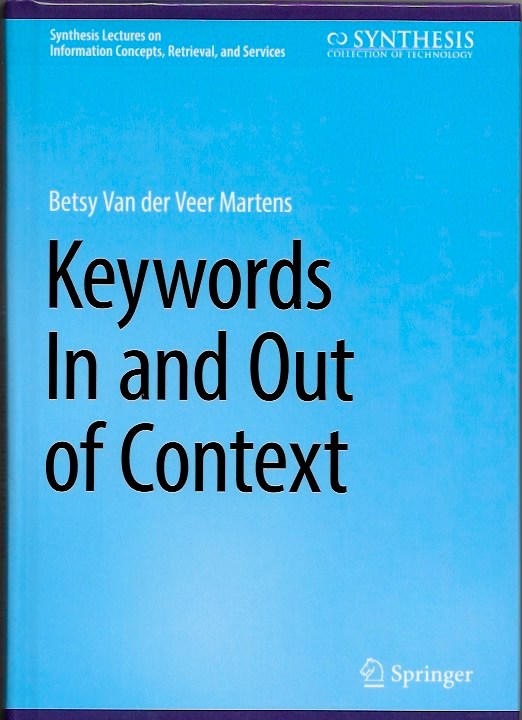
This site is intended to provide additional information related to my book Keywords In and Out of Context, published in Springer’s Synthesis Lectures on Information Concepts, Retrieval, and Services series.
I am Betsy Van der Veer Martens, professor emerita at the University of Oklahoma’s School of Library & Information Studies, and my most recent article is “On Thresholds: Signs, Symbols, and Significance” in the Journal of Documentation.
 Keywords In and Out of Context